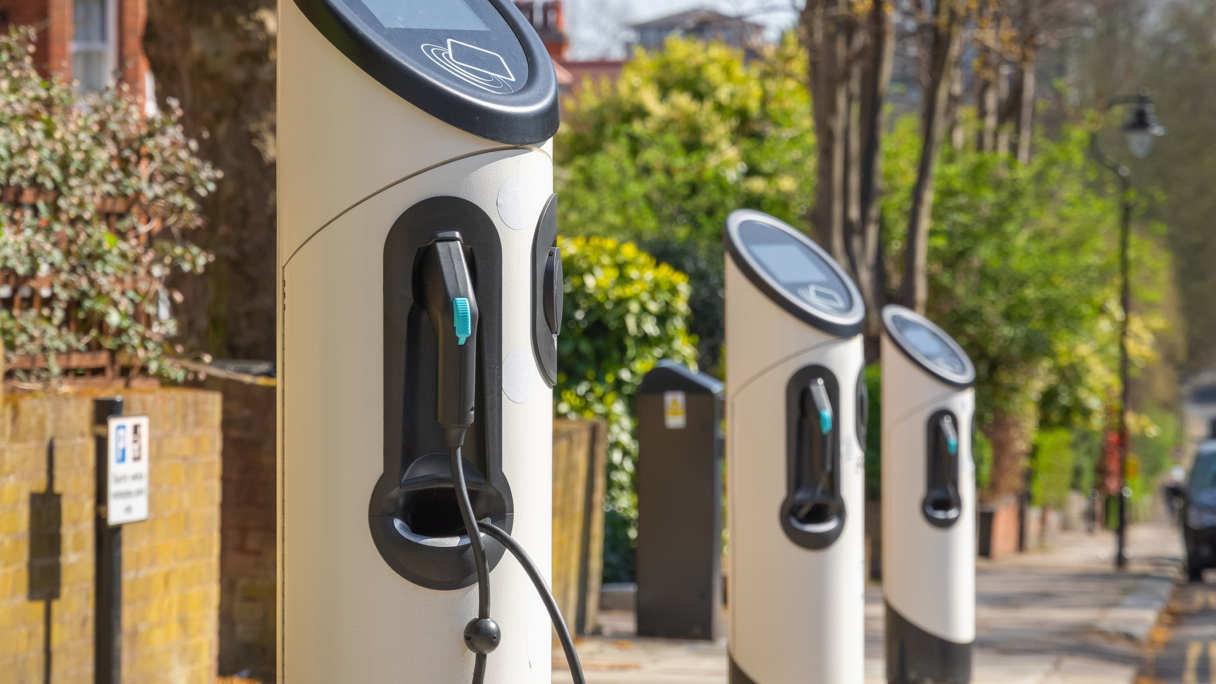
You breathe in. The air is clean and fresh. Things are quiet and peaceful, except for the faint chirp of distant birdsong.
For decades, a scene such as this seemed incompatible with modern life’s need for mobility.
In 2018, cars and vans accounted for around a fifth of the UK’s total emissions.1 Our cities, log-jammed with vehicles, pumping out more and more exhaust fumes.
But technological advances in electric vehicles have made the vision of a clean, emission-free environment across the UK tangible.
Action has already been taken. In 2020 the UK government passed law banning the sale of new petrol and diesel cars and vans from 2030, with new hybrids banned from 2035.
Right now, around 16.5% of new car sales in the UK are electric. But this percentage is expected to climb rapidly.
It’s estimated that there will be between eight and eleven million hybrid and electric cars on UK roads by 2030, and as many as 25 million by 2040.2
The transition to electric is most welcome and something to be excited about.
But there is a major hurdle: infrastructure.
Plugs without sockets
Today there are around 42,5003 public charging points for electric vehicles across the UK.
If the adoption of electric vehicles continues at the pace expected, we need our charging infrastructure to scale up in a big way.
To give some idea, the government has set a target of 300,000 public chargers by 2030.4
But just 9,000 new chargers were added to the network in 2022. If we continue at the same rate, we will undershoot the government target by almost 200,000 chargers.
And the problem is more acute than these numbers first reveal, because the UK has deeply underserved regions. For example, 31% of existing electric vehicle chargers are in London, versus 13% in the Southeast, 4% in Wales, and 1% in Northern Ireland, where 400 charging points serve a population of 1.8 million.
Accelerating the next generation of sustainable infrastructure
As electric vehicles become ubiquitous, there’s a clear need to speed up the expansion of electric vehicle charging infrastructure in the UK, especially in the most underserved regions.
The UK government’s ban on the sale of new diesel and petrol cars and vans will apply to all regions of the country. If we’re going to make the transition to electric vehicles a reality, we will need infrastructure to service drivers across the entire country.
Electric vehicle charging is now a mature technology with several tried and tested business models. What’s needed is committed and patient investment into the space.
What does the future look like?
The UK needs to invest in a blend of charger types to suit drivers’ needs. That includes 7 kW home charging (where you can charge your car overnight). It includes 22 kW ‘fast’ destination charging – for example at a hotel or office where you can park your car and charge for a few hours.
We also need to roll out 50-150 kW ‘rapid’ charging – often at service stations or forecourts where you can charge in less than an hour. More and more of these types of chargers are really needed to help drivers with “range anxiety”.
This means there’s a range of proven business models where investors can play their part in transforming the UK’s infrastructure.
Investing in building sustainable infrastructure will not only improve the experience of today’s electric vehicle drivers, but it should encourage more people to purchase an electric vehicle, speeding up the transition away from petrol and diesel cars.
Sustainable Infrastructure at Octopus
We’re committed to rolling out the next generation of sustainable infrastructure across the UK.
That’s why, through our Sustainable Infrastructure strategy, we invested in Weev, an electric vehicle (EV) charge point operator based in Northern Ireland.
Octopus, through its Sustainable Infrastructure strategy, is backing Weev’s £50m rollout plan to address the shortage of charging infrastructure in Northern Ireland.
Through our Sustainable Infrastructure strategy, we aim to provide growth capital to sustainable infrastructure companies with proven technology, which have transformative potential and can help meet the UK’s net zero ambitions.
Lukasz Michalak, Investment Director in the Sustainable Infrastructure team, says “We’re focused on investing in sustainable infrastructure businesses tackling climate change and supporting levelling-up ambitions across the UK. Weev is the perfect example of the next generation of infrastructure companies doing just that. By backing Weev, we see a great opportunity to deliver a positive impact to Northern Ireland’s communities, while meeting the financial objectives of our investors.”
[1]Office for National Statistics – UK Environmental Accounts, Atmospheric emissions datasets
[2]Local Government Association
[3]Number of charging devices registered on Zapmap at April 2023
[4] Taking charge: the electric vehicle infrastructure strategy