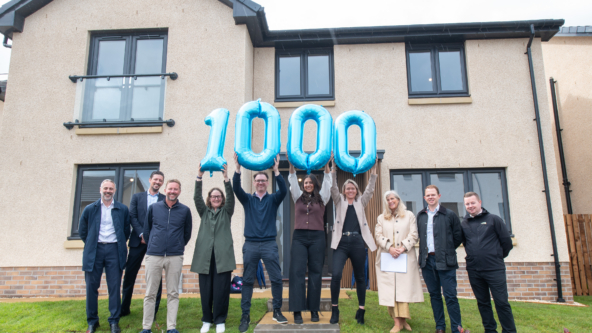
Just a decade ago, the idea of delivering £1 billion of construction into the UK Integrated Retirement Community (IRC) sector would have seemed ambitious. Today, it is a reality.
Across six years, three strategies and twenty developments, the Octopus Capital Retirement team has underwritten and overseen almost £1 billion (£997 million) of construction contracts, creating more than £2 billion of completed real estate value and helping establish IRCs as one of the UK’s most important emerging real estate sectors driven by the growing number of baby-boomer retirees.
In many established asset classes, £1 billion of construction delivery is notable. In retirement living, it’s transformative.
The sector has historically suffered from sporadic investment, fragmented delivery, and a chronic undersupply of purpose-built housing for older people. Against that backdrop, delivering twenty retirement communities represents more than a successful investment programme. It also signifies a step-change in the sector’s maturity.
For those of us responsible for underwriting development risk and overseeing delivery, reaching this milestone also provides a unique opportunity to reflect on what the first £1 billion has taught us and what the next £1 billion might look like.
One thing is already becoming clear. The next chapter of retirement living will not simply be bigger. It will be broader, and increasingly, it will be rented.
A unique view across the entire value chain
Construction underwriting is often viewed as a technical exercise focused on costs, programmes, and contractual risk. The reality is very different.
At Octopus Capital, our Retirement team occupies a unique position within the sector. We sit at the intersection of investors, developers, operators, consultants, contractors, local authorities, and residents.
Few market participants have visibility across every stage of the process, from initial investment committee papers through planning, procurement, construction, practical completion, sales, and operations.
This position creates something invaluable: a deep perspective.
As construction and development professionals within an asset management business, we don’t view the sector through a single lens. We can compare development strategies, procurement approaches, contractor performance, emerging technologies, operational outcomes, and resident demand across multiple projects simultaneously.
Every scheme contributes another piece of evidence, every challenge generates another lesson, and every successful solution becomes part of a growing body of knowledge that can be applied across current and future projects.
This has allowed us to build a clear understanding of what drives success in retirement community development and – equally importantly – where risks reside. This creates an advantage that becomes more valuable with every project delivered.
Underwriting £1 billion of construction
Through the three strategies we manage, supported by approximately £700 million of equity commitments, we have underwritten twenty retirement community developments.
Each scheme undergoes rigorous due diligence before selection.
The objective is to understand how risks can evolve over the lifecycle of a project, and to ensure appropriate mitigations are in place before capital is deployed. This approach has helped navigate some of the most challenging construction market conditions seen in recent decades.
The portfolio has lived through Brexit-related uncertainty, a global pandemic, labour shortages, material inflation, supply-chain disruption, major conflicts and rapidly rising interest rates. Yet developments have continued to progress through planning and construction to reach practical completion.
Experience matters more than ever
Large-scale development has always been a people business. Technical processes, governance frameworks, and contractual protections all matter, but ultimately successful delivery depends on experience and judgement.
We manage risk through our expertise and relationships. My colleague and I are Fellows of our respective professional bodies, and we both have extensive relationships with consultants, contractors, developers, and investors. We bring experience across all phases of development, construction, and project delivery.
Development partners are assessed on capability, track record and financial standing. Designs are reviewed to ensure they meet both resident needs and operational requirements. Procurement strategies are interrogated. Contractor selection is considered, and detailed conversations are held with board directors. Planning factors, buildability, and methods of construction are all examined in detail too.
Our experience allows us to identify risks early, challenge appropriately, and mitigate before they become problems. Importantly, successful underwriting means understanding and managing risk better than most, rather than avoiding it altogether.
Creating more than buildings
What has been delivered extends far beyond bricks and mortar. Collectively, the schemes will:
- Provide 2,338 age-adjusted homes
- Release approximately 9,352 bedrooms back into the wider housing market
- Deliver an estimated £52.6 million saving to the NHS
- Create approximately 16,600 construction and operational jobs
These figures reinforce an increasingly important point. Integrated Retirement Communities shouldn’t be viewed purely as a residential asset class. They are social infrastructure too.
When older people move into high-quality retirement communities, housing stock is released back into the market, pressure on healthcare systems reduces, loneliness is tackled, and employment opportunities are created. Few real estate sectors can demonstrate such direct, measurable societal impact.
ESG has become a fundamental investment principle
The first £1 billion has also demonstrated that sustainable outcomes and commercial outcomes are becoming increasingly inseparable.
Every development has targeted a minimum BREEAM Very Good rating, while three schemes have achieved Excellent. New build homes have EPC B ratings, supporting lower energy use and reducing operational costs for residents. But sustainability is no longer solely measured in environmental terms.
The developments have supported apprenticeships, promoted mental health initiatives, engaged with schools and community groups, and introduced services such as Octopus Legacy. This gives construction staff, operatives and residents free wills and practical support for later-life planning.
The most successful developments increasingly recognise that social value is not a by-product of development. It is a core deliverable.
What could the next £1 billion look like?
The future of retirement living is unlikely to be a simple continuation of the last six years.
Demographics remain overwhelmingly supportive. The UK population is ageing, specialist housing provision remains significantly undersupplied, institutional appetite for operational real estate continues to grow, and customer expectations are evolving.
A growing proportion of future residents may not wish to purchase their retirement home outright. Many will seek flexibility, freedom from home-ownership responsibility and the ability to access high-quality services without making a substantial capital commitment.
This presents a compelling opportunity for rental-led retirement communities.
Residents benefit from lower barriers to entry, broader accessibility and greater flexibility as circumstances change.
Investors gain access to long-term, inflation-linked income streams supported by powerful demographic fundamentals.
And operators can build deeper, longer-term relationships with residents.
For the wider sector, they may represent the catalyst needed to accelerate growth and bring retirement living to a significantly broader audience.
In many respects, the rental opportunity feels similar to where the for-sale IRC market stood a decade ago: proven in concept, increasingly demanded by consumers and attracting growing institutional interest.
If the first £1 billion helped establish that the UK can deliver retirement communities successfully at scale, the next £1 billion may prove that retirement living can become a genuinely mainstream housing tenure.
Looking ahead
The significance of delivering £1 billion of construction into the IRC sector lies less in the scale of investment rather than in what the achievement represents.
It demonstrates that retirement communities can be delivered repeatedly, safely, and successfully across multiple market cycles. That experienced underwriting and active oversight create tangible value, and that this sector can continue to move decisively toward the mainstream.
Perhaps most importantly, it provides a foundation for what comes next.
The first £1 billion helped support the establishment of the sector.
There’s now the potential to reshape and mature the sector further, building on that foundation.
And if that future increasingly includes rental-led retirement communities alongside traditional ownership models, the impact could extend far beyond real estate – creating a more accessible, more flexible, and more resilient housing solution for an ageing population across the UK.
Source: Octopus Capital, August 2026.