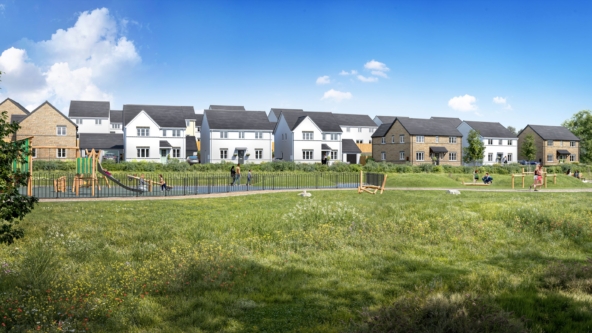
Across Europe, demographic change and persistent undersupply in housing, healthcare and education are reshaping both how societies function and how investors think about resilience. As populations age, urban centres expand and public resources come under increasing pressure, social infrastructure is moving further into focus.
For investors looking for greater visibility on cashflows, social infrastructure offers a combination that is increasingly difficult to ignore: long-term relevance alongside resilient income.
When it’s delivered well, social infrastructure rarely makes headlines, yet it plays a fundamental role in how society functions.
It’s the housing people need throughout life, the education that shapes their development, the healthcare systems that support them, and the care they receive later on. These are the assets that maintain everyday life at every stage.
That longevity matters both socially and financially. Assets that remain essential over decades have consistently generated long-dated, stable income streams – a characteristic that’s becoming increasingly valuable in today’s uncertain market environment.
Octopus has been investing into and developing social infrastructure for almost 20 years – from medical centres to affordable housing and care homes – giving us first-hand insight into how these assets perform across cycles and why their long-term relevance matters.
Why it matters now
We believe there is a clear opportunity now to meet growing demand for key social infrastructure throughout Europe with private capital seeking visible, long-dated returns.
From an investor perspective, the question is no longer simply where income comes from, but how durable it is.
Stability, predictability, and long-term relevance are increasingly defining what “defensive” investing really means. As market volatility persists, attention is shifting toward assets that can offer continuity of service and income underpinned by structural demand.
Traditional assumptions about stability are being tested, and attention is shifting towards assets that can offer visibility on income, downside protection and long-term relevance.
At the same time, long-term demand for social infrastructure across Europe continues to build.
Populations are ageing. By 2050, more than 30% of Europe’s population is expected to be aged 65 or over1, placing sustained pressure on healthcare and care provision. Urban centres are expanding, and household structures are evolving. Across housing, healthcare and education, supply is struggling to keep pace with need.
In many European countries, structural housing shortages already run into the millions of homes. Public balance sheets alone are unlikely to meet that demand. Governments are therefore relying more heavily on private capital to help bridge the gap, supported by evolving policy frameworks and increasing public–private collaboration.
From an investor perspective, this shift is already visible in how capital is being allocated. Assets that combine essential services with long-dated, visible cashflows are moving firmly into focus.
The combination of long-term relevance and resilient income is becoming harder to ignore.
Resilient income starts with essential demand
Social infrastructure differs from most asset classes in one fundamental way: demand is not discretionary.
Housing, healthcare and care services are needed regardless of the economic cycle, which helps stabilise occupancy and utilisation. Revenues are often supported by long-term leases, regulated frameworks or government-backed counterparties, providing a high degree of visibility on cashflows.
Many of these assets also benefit from explicit or implicit inflation linkage, which has proven its value in maintaining real income through periods of elevated inflation.
Positioned between real estate and core infrastructure, social infrastructure combines the income-generating characteristics of property with the essential nature of infrastructure.
In practice, this plays out in areas such as affordable housing, care homes and retirement living – sectors that directly reflect Europe’s structural imbalances in supply and demand, and where we focus our investment at Octopus Capital.
We also support these sectors through transitional financing, helping high-quality operators grow sustainably and bridging the funding gaps that can otherwise limit regeneration and development.
This approach builds on broader expertise in managing operationally complex real assets, underpinned by a focus on disciplined execution, partnership alignment and transparency.
However, performance is not determined by the physical asset alone. The quality-of-service delivery is fundamental to how these assets operate and perform over time.
Resilience under pressure
The resilience of social infrastructure is often most visible when markets are under stress. And perhaps the clearest demonstration of this resilience came during the Covid-19 pandemic
While many asset classes experienced disruption, essential services continued to operate. Care homes, in particular, remained operational under extremely challenging conditions, with residents continuing to require support.
Throughout this period, Octopus Capital’s care home portfolio delivered uninterrupted care and full rent collection. It reinforced how essential these assets are not just financially, but operationally and socially, too.
These assets form part of a wider system. Their importance becomes most evident when that system is under strain, helping to ease pressure on hospitals and support patient transitions out of acute care settings.
Resilience, in this context, extends beyond balance sheets. It’s operational, social, and systemic.
A Europe-wide structural imbalance
Across Europe, the same underlying imbalance is evident – long-term demand continues to grow, while supply struggles to keep pace.
This is particularly visible in areas such as affordable housing, senior living and healthcare. In many cases, the shortfall in affordable housing alone is estimated in the hundreds of thousands if not millions of units2, underlining the scale of the challenge.
While these trends are consistent, market maturity varies. Some countries have well-established institutional investment in social infrastructure, while others are still developing. This creates both challenge and opportunity.
More established markets provide a track record of how these assets can perform, while less mature markets offer significant scope for growth.
At the same time, social infrastructure remains inherently local. Service delivery models, regulatory frameworks and user expectations differ across countries, making local expertise critical.
So, while sector knowledge and operational frameworks can transfer across markets, they must be adapted to reflect local conditions.
Risk, quality and operational focus
The service-led nature of social infrastructure also shapes how risk is understood.
Risks are not solely concentrated in the physical asset and instead are more closely linked to how it is operated. Service quality, operator performance and regulatory compliance all have a direct influence on outcomes.
Long-term performance depends on service quality, operator strength and regulatory compliance. Reputational considerations also play an important role, given how closely these assets are connected to the communities they serve.
Managing that risk requires careful operator selection, ongoing oversight, engagement with regulators and a willingness to act early when issues arise.
Ultimately, delivering sustainable returns depends as much on operational capability as it does on capital allocation. In social infrastructure, investment quality and service quality are closely linked.
For us, operational capability is at the heart of how we invest. Our focus on governance, alignment, and transparency supports long-term operational resilience – ensuring that the operators we work with can maintain high standards of care and service even in complex environments.
A clear example is our dedicated Quality Assurance Team of registered nurses, who work alongside operators within our care home portfolio to help maintain standards of care, compliance and service quality.
This level of operational engagement helps ensure that performance is not only maintained, but strengthened over time – reinforcing how service quality and long-term investment resilience are closely linked.
Social impact and long-term value
Social infrastructure is closely tied to the communities it serves. These assets support access to housing, healthcare, education and care, and play an important role in local economies.
In my experience, good quality social infrastructure helps communities prosper, socially and economically. It can have a real multiplier effect.
For investors, this connection to social outcomes is not separate from the investment case – it reinforces it.
Assets that are aligned with essential needs tend to remain relevant and well utilised over time, supporting long-term performance.
There’s also increasing focus on how that impact is measured. From resident outcomes to environmental performance – investors are placing greater emphasis on ensuring these assets deliver both social value and long-term sustainability.
From local need to institutional scale
The scale of the opportunity across Europe is significant. Meeting long-term demand for social infrastructure will require substantial investment over the coming decades, with estimates running into the hundreds of billions of euros.
And public capital alone is unlikely to be sufficient.
There is growing recognition that connecting local opportunities with institutional capital is key to scaling the sector.
This requires platforms that combine:
- local expertise
- operational discipline
- long-term capital
- a focus on sustainable outcomes
Governments across the region recognise that public balance sheets cannot meet these needs alone – and private capital participation is accelerating as a result.
Our model of combining long-term investment partnerships with operational know-how is designed to bridge this divide, helping local social infrastructure deliver institutional-scale outcomes.
Looking ahead
Social infrastructure sits at the intersection of several long-term trends: resilient income, structural demand, inflation linkage and essential societal need.
In Europe, demographic trends and supply constraints are magnifying these dynamics, while policy momentum builds. Investors are increasingly acknowledging that social infrastructure can anchor portfolios with purpose – combining financial resilience with measurable social benefit.
Rather than being defined by where it sits within a portfolio, the case for social infrastructure is increasingly demonstrated through how it performs.
For investors seeking income that is genuinely long-term, stable, and socially relevant, social infrastructure in Europe is emerging as an asset class that is difficult to ignore – and one where Octopus Capital continues to play an active role in helping to shape the future of long-term, purpose-driven investment.
1 Population ageing in Europe: from challenge to potential – February 2026
2 European Investment Bank – Why is there a housing crisis and how do we fix it?